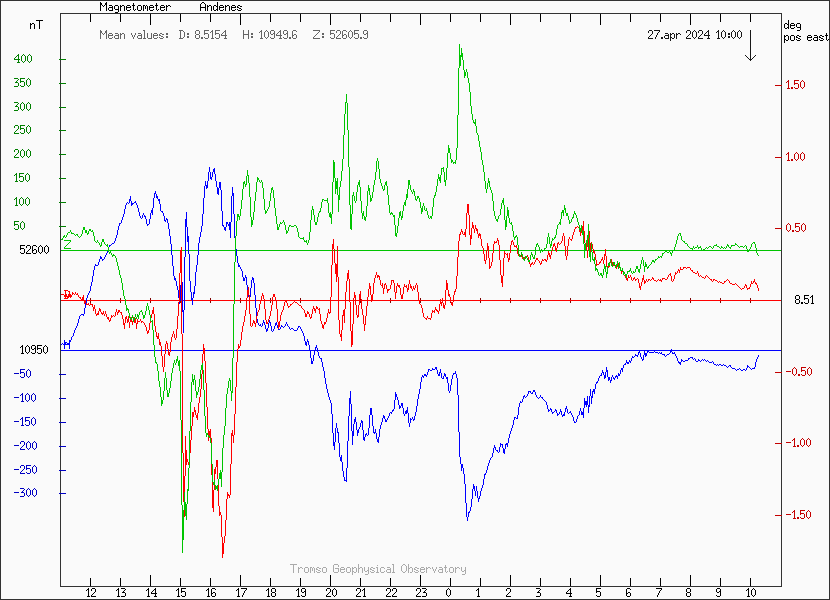
The geomagnetic field was at quiet to minor storm levels on October 31 under the influence of effects associated with CH1324 and CH1326. Solar wind speed at SOHO ranged between 521 and 745 km/sec, averaging 659 km/sec (+91 km/sec compared to the previous day). The high latitude magnetometer at Andenes recorded unsettled to major storm levels. The above 10 MeV proton flux was at background levels all day (some sensor contamination due to high electron flux levels was observed during the latter half of the day, just like over the previous rotations with CH1324).
Solar flux density measured at 17h UT on 2.8 GHz was
115.4 -
decreasing 42.2
over the previous solar rotation. The measurement at 20h UT was
enhanced by a long duration C7.1 event at the northeast limb.
The 365 day average solar flux at 1 AU was 161.97 (183 days ago). The 81 day
average solar flux at 1 AU was 150.8 (41 days ago, this is 51.7% of the total SC25 solar flux range from the max 81
day average peak on September 4, 2024 at 227.3 and an average 81 day flux of
69 at solar minimum).
SC25 365d peak:
195.9 on October 13, 2024.
The Potsdam WDC planetary A index was 24 (STAR Ap - based on the average of three hour interval ap indices: 24.3). Three hour interval K indices: 55434332 (planetary), 34334322 (Boulder), 55443463 (Andenes).
The background x-ray flux is at the class B6 level (GOES 19).
At the time of counting spots (see image time), spots were observed in 9 active regions using 2K resolution (SN: 135) and in 7 active regions using 1K resolution (SN: 83) SDO/HMI images.
AR 14261 [S05W79] decayed slowly and quietly.
AR 14266 [N17W67] decayed slowly and quietly.
AR 14267 [N02W37] decayed slowly and quietly.
AR 14269 [S11W40] decayed slowly and quietly.
Spotted regions not observed (or interpreted
differently) by SWPC/USAF:
S11555 [N12E05] was quiet and stable.
S11562 [S12W09] was quiet and stable.
S11568 [N30W07] was quiet and stable.
S11571 [N19W14] was quiet and stable.
S11573 [S15E17] was quiet and stable.
Active regions behind the northeast limb produced C1 flares: C1.8 flare @ 02:00, C1.1 @ 08:37, C1.7 @ 12:20 UT
AR S11574 is rotating into view early on November 1
and was located at N22E83 at 06:15 UT.

C2+ flares
| Magnitude | Peak time (UT) | Location | Source | Recorded by | Comment |
| C3.7 | 16:53 | behind northeast limb | S11574 | GOES18 | |
| C7.1 | 20:42 | behind northeast limb | S11574 | GOES18 | LDE, flare began at 19:37 UT |
| C2.3 | 23:26 | 14271 | GOES18 |
October 29, 31: No obviously Earth directed CMEs observed in available
coronagraph imagery.
October 30: Several full and partial halo backsided CMEs were
observed during the day, mainly from locations behind the east limb. A strong
type II radio sweep was recorded between 04:28 and 04:45 UT and was associated
with one of these CMEs. A filament eruption in the central northern
hemisphere before noon may be the source of a partial halo CME observed first
off the north pole and the northwest limb. A CME from behind the northeast
limb makes it difficult to determine if the CME has a significant chance of
impacting Earth. In the case of an impact, it will likely occur on November
2.
[Coronal
hole history (since October 2002)]
[Compare today's report to the situation one solar rotation ago:
28 days ago
27 days ago
26 days ago]
A recurrent positive polarity southern hemisphere coronal hole (CH1324) was Earth facing on October 26-29, CH1324 has decayed over the last solar rotation. A positive polarity northern hemisphere coronal hole (CH1327) will be Earth facing on October 29-30. A negative polarity trans equatorial coronal hole (CH1328) will likely rotate across the central meridian on November 4-5.
The geomagnetic field is expected to be at quiet to active levels on November 1-2 due to effects associated with CH1324 and CH1327. The October 30 CME could cause unsettled to minor storm levels on November 2-3, if it has Earth directed components.
| Coronal holes (1) | Coronal mass ejections (2) | M and X class flares (3) |
1) Effects from a coronal hole could
reach Earth within the next 5 days. When the high speed stream has arrived
the color changes to green.
2) Effects from a CME are likely to be observed at Earth within 96 hours.
3) There is a possibility of either M or X class flares within the next 48 hours.
Green: 0-30% probability, Yellow: 30-70% probability, Red: 70-100% probability.

(Click on image for 2K resolution).
4K resolution.
Compare to the previous day's image. 0.5K image
When available the active region map has a coronal hole polarity overlay where red (pink) is negative and blue is positive.
Data for all officially numbered solar regions according to the Solar Region Summary provided by NOAA/SWPC, all other regions are numbered sequentially as they emerge using the STAR spot number. Comments are my own, as is the STAR spot count (spots observed at or inside a few hours before midnight) and data for regions not numbered by SWPC or where SWPC has observed no spots. SWPC active region numbers in the table below and in the active region map above are the historic SWPC/USAF numbers. SWPC data considered to be not sufficiently precise (location, area, classification) are colored red.
| Active region | SWPC date numbered STAR detected |
Spot count | Location at midnight | Area | Classification | SDO / HMI 4K continuum image with magnetic polarity overlays |
Comment | ||||
|---|---|---|---|---|---|---|---|---|---|---|---|
| SWPC/ USAF |
STAR | SWPC | STAR | Current | Previous | ||||||
| 2K | 1K | ||||||||||
| 14261 | 2025.10.19 2025.10.20 |
1 | 2 | 1 | S06W81 | 0010 | AXX | AXX |
 |
 |
was AR S11543 area: 0005 location: S05W79 |
| 14267 | 2025.10.22 2025.10.23 |
2 | 12 | 5 | N02W39 | 0110 | CSO | CSO |
 |
 |
was AR S11549 area: 0190 location: N02W37 |
| 14266 | 2025.10.22 2025.10.23 |
3 | N17W65 | 0006 | AXX |
 |
 |
was AR S11550 location: N17W67 |
|||
| 14269 | 2025.10.24 2025.10.25 |
1 | 5 | 1 | S13W41 | 0010 | AXX | BXO |
 |
 |
was AR S11554 location: S11W40 |
| S11555 | 2025.10.25 | 3 | 1 | N12E05 | 0006 | BXO |
 |
 |
|||
| 14270 | 2025.10.26 2025.10.27 |
S06W61 |
was AR S11559 location: S07W56 |
||||||||
| S11560 | 2025.10.26 | S30W46 | |||||||||
| S11562 | 2025.10.27 | 6 | 2 | S12W09 | 0020 | CRO |
 |
 |
beta-gamma | ||
| S11563 | 2025.10.27 | S02E13 | |||||||||
| S11564 | 2025.10.27 | N24W46 |
 |
||||||||
| S11566 | 2025.10.28 | N05W17 | |||||||||
| 14271 | 2025.10.28 2025.10.30 |
S09E40 |
 |
was AR S11567 location: S09E39 |
|||||||
| S11568 | 2025.10.29 | 5 | 2 | N30W07 | 0008 | BXO |
 |
 |
|||
| S11569 | 2025.10.30 | N16W22 |
 |
||||||||
| S11570 | 2025.10.30 | N20W25 |
 |
||||||||
| S11571 | 2025.10.30 | 5 | 1 | N19W14 | 0008 | BXO |
 |
 |
|||
| S11572 | 2025.10.30 | S15W18 |
 |
||||||||
| S11573 | 2025.10.30 | 4 | S15E17 | 0005 | BXO |
 |
 |
||||
| Total spot count: | 4 | 45 | 13 | ||||||||
| Sunspot number: | 34 | 135 | 83 | (total spot count + 10 * number of spotted regions) | |||||||
| Weighted SN: | 9 | 53 | 21 | (Sum of total spot count + classification weighting for each AR. Classification weighting: X=0, R=3, A/S=5, H/K=10) | |||||||
| Relative sunspot number (Wolf number): | 37 | 74 | 66 | ||||||||
| Month | Average solar flux | International sunspot number (WDC-SILSO) |
Smoothed sunspot number (4) | Average
ap (3) |
|
|---|---|---|---|---|---|
| Measured | 1 AU | ||||
| 2024.05 | 187.7 | 191.9 | 172.1 | 149.1 (+4.6) | 23.56 (SC25 peak) |
| 2024.06 | 184.3 | 190.2 | 164.1 | 152.8 (+3.7) | 10.24 |
| 2024.07 | 196.6 | 203.0 | 196.8 | 155.0 (+2.3) | 7.13 |
| 2024.08 | 246.1 (cycle peak) |
252.2 | 216.0 (SC25 peak) | 156.8 (+1.8) | 15.96 |
| 2024.09 | 195.7 | 197.8 | 141.1 | 159.4 (+1.6) | 15.36 |
| 2024.10 | 221.0 | 219.6 | 165.8 | 160.9 (+1.5) (SC25 solar max) | 18.99 |
| 2024.11 | 199.6 | 195.3 | 154.1 | 157.2 (-3.7) | 9.33 |
| 2024.12 | 197.3 | 191.2 | 154.6 | 151.2 (-6.0) | 8.42 |
| 2025.01 | 190.3 | 184.2 | 137.0 | 146.2 (-5.0) | 13.17 |
| 2025.02 | 184.2 | 179.7 | 155.7 | 139.8 (-6.4) | 14.42 |
| 2025.03 | 163.7 | 162.1 | 134.2 | 135.9 (-3.9) | 15.96 |
| 2025.04 | 162.5 | 163.6 | 141.4 | 133.3 (-2.6) | 17.62 |
| 2025.05 | 135.3 | 138.3 | 78.5 | (128.5 projected, -4.8) | 17.26 |
| 2025.06 | 131.3 | 135.4 | 114.6 | (123.8 projected, -4.7) | 21.43 |
| 2025.07 | 137.8 | 142.3 | 125.6 | (120.6 projected, -3.2) | 11.80 |
| 2025.08 | 154.9 | 158.7 | 133.5 | (117.0 projected, -3.6) | 9.97 |
| 2025.09 | 154.4 | 156.0 | 129.8 | (113.1 projected, -3.9) | 14.1 |
| 2025.10 | 139.5 | 138.6 | 114.6 | (109.1 projected, -4.0) | 15.9 |
| 2025.11 | (1) | (2A / 2B) / 137.7 (2C) | (106.8 projected, -2.3) | () | |
| 2025.12 | (105.3 projected, -1.5) | ||||
| 2026.01 | (101.2 projected, -4.1) | ||||
| 2026.02 | (97.1 projected, -4.1) | ||||
| 2026.03 | (92.8 projected, -4.3) | ||||
| 2026.04 | (89.0 projected, -3.8) | ||||
1) Running average based on the daily 20:00 UTC observed solar flux value
at 2800 MHz and any corrections applied to that measurement.
2A) Current impact on the monthly sunspot number based on the Boulder
(NOAA/SWPC) sunspot number (accumulated daily sunspots / month days).
2B) Boulder SN current month average to date.
2C) STAR SDO 1K Wolf number 27 day average.
3) Running average based on the quicklook and definitive Potsdam WDC ap
indices. Values in red
are based on the definitive international
GFZ Potsdam WDC ap
indices.
4) Source: WDC-SILSO, Royal Observatory
Of Belgium, Brussels

Sunspot activity was on a decreasing trend from September
2024 until mid August 2025 (using the average solar flux over 3 solar rotations as a proxy).
Then a strong surge in activity saw solar flux peak in late August 2025 just
below the largest peaks seen in 2024. A slow decrease in activity from the
August level has been observed in September and October 2025.
All 365 day smoothed sunspot numbers reached a maximum on October 11-12, 2024.
This became the peak of SC25 (365 day smoothed peaks: STAR 1K: 236.1, STAR 2K: 364.3, NOAA SN: 156.0, ISN: 163.9),
while the 365d
smoothed solar flux peaked on October 13, 2024, just 1.7% below the SC23
peak, and 62.6% above the SC24 peak.
--------------------------------------------------------------------------------------
This report has been prepared by Jan Alvestad. It is based on the analysis of data from whichever sources are available at the time the report is prepared. All time references are to Universal Time. Comments and suggestions are always welcome.
SDO images are courtesy of NASA/SDO and the AIA, EVE, and HMI science teams.