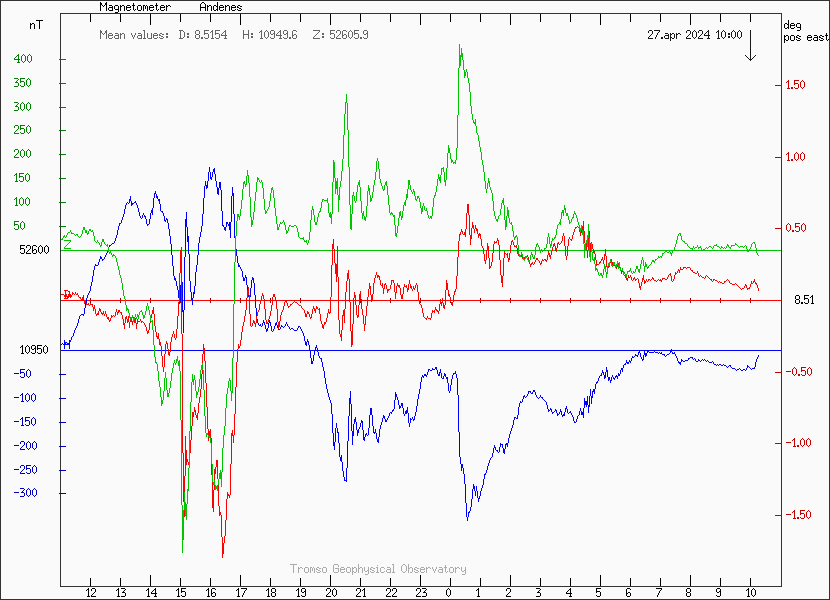
The geomagnetic field was at quiet to minor storm levels on October 13 under the influence of effects associated with CH1322. Solar wind speed at SOHO ranged between 643 and 798 km/sec, averaging 693 km/sec (-10 km/sec compared to the previous day). The high latitude magnetometer at Andenes recorded unsettled to major storm levels. The above 10 MeV proton flux was at background levels all day.
Solar flux density measured at 20h UT on 2.8 GHz was
141.4 -
increasing 6.5
over the previous solar rotation.
The 365 day average solar flux at 1 AU was 165.21 (183 days ago). The 81 day
average solar flux at 1 AU was 154.5 (41 days ago, this is 54.0% of the total SC25 solar flux range from the max 81
day average peak on September 4, 2024 at 227.3 and an average 81 day flux of
69 at solar minimum).
SC25 365d peak:
195.9 on October 13, 2024.
The Potsdam WDC planetary A index was 21 (STAR Ap - based on the average of three hour interval ap indices: 21.1). Three hour interval K indices: 54343233 (planetary), 55344322 (Boulder), 56543366 (Andenes).
The background x-ray flux is at the class C1 level (GOES 19).
At the time of counting spots (see image time), spots were observed in 15 active regions using 2K resolution (SN: 320) and in 13 active regions using 1K resolution (SN: 230) SDO/HMI images.
AR 14246 [N22W27] developed quickly gaining
many spots and with a large increase in the penumbral area. The region has
multiple magnetic delta configurations and X class flare potential. C1
flares: C1.3 @ 02:53, C1.9 @ 04:53, C1.4 @ 10:12, C1.9 @ 14:42, C1.8 @
17:30, C1.8 @ 17:59, C1.6 @ 18:44, C1.5 @ 20:06, C1.6 @ 21:00, C1.5 @ 21:21,
C1.4 @ 21:48, C1.5 @ 22:40, C1.9 @ 23:03, C1.4 @ 23:36, C1.3 @ 23:54 UT
AR 14247 [S12W63] was mostly stable and in slow decay. C1 flares:
C1.6 @ 20:11, C1.4 @ 20:25, C1.5 @ 20:41 UT
AR 14248 [N06E07] decayed slowly and quietly. The leader spot could
soon merge with AR 14250. Note that SWPC/USAF made a mistake and swapped
region numbers on October 12 for this AR and AR 14250. The original
numbering will be kept here for data consistency and integrity reasons.
AR 14249 [S19E12] was quiet and stable.
AR 14250 [N06E01] lost intermediate spots and gained area. The large
trailing penumbra has several small magnetic delta configurations and a
major flare is possible. C1 flares: C1.6 @ 02:22, C1.8 @ 12:33 UT
AR 14251 [N18E27] was quiet and stable.
AR 14252 [S14E53] was quiet and stable.
AR 14253 [S17W24] decayed slowly and quietly.
Spotted regions not observed (or interpreted
differently) by SWPC/USAF:
S11515 [N18W06] reemerged with tiny spots.
S11520 [N10E41] decayed slowly and quietly.
New AR S11521 [N09W19] emerged with tiny spots.
New AR S11522 [N13E16] was observed with tiny spots in an old plage
area.
New AR S11523 [N10E84] rotated into view with a mature spot.
New AR S11524 [S04E59] was observed with a tiny spot in an old
plage area.
New AR S11525 [S25E49] was observed with tiny spots in an old plage
area.
C2+ flares
| Magnitude | Peak time (UT) | Location | Source | Recorded by | Comment |
| C6.4 | 00:13 | N05E14 | 14250 | GOES18 | simultaneous flare in AR 14246 |
| C9.3 | 00:44 | N23W12 | 14246 | GOES18 | LDE |
| C2.4 | 04:02 | N04E13 | 14250 | GOES18 | |
| C5.8 | 04:13 | 14246 | GOES18 | ||
| M1.9/1N | 05:25 | N22W17 | 14246 | GOES18 | small simultaneous flare in AR 14250 |
| C4.1 | 06:46 | 14246 | GOES18 | ||
| C7.6 | 06:54 | 14246 | GOES18 | ||
| C3.9 | 07:12 | 14250 | GOES18 | ||
| C5.7 | 07:30 | N04E11 | 14250 | GOES18 | |
| C9.8 | 07:47 | N21W18 | 14246 | GOES18 | |
| M2.7/1F | 09:19 | N22W17 | 14246 | GOES18 | |
| C2.5 | 09:58 | 14246 | GOES18 | ||
| C9.5 | 10:47 | 14250 | GOES18 | ||
| C2.5 | 11:58 | 14246 | GOES18 | ||
| C3.5 | 13:02 | 14246 | GOES18 | ||
| M1.3/1F | 13:18 | N23W20 | 14246 | GOES18 | moderate type II radio sweep, CME |
| C4.3 | 13:57 | 14246 | GOES18 | ||
| C2.6 | 15:43 | N22W24 | 14246 | GOES18 | |
| C3.4 | 16:02 | 14246 | GOES18 | ||
| C7.2 | 16:53 | 14246 | GOES18 | ||
| C2.1 | 17:17 | 14246 | GOES18 | ||
| C3.0 | 18:14 | 14246 | GOES18 | ||
| C2.9 | 18:22 | 14246 | GOES18 | ||
| C6.1 | 18:59 | 14246 | GOES18 | ||
| C8.0 | 19:08 | 14246 | GOES18 |
October 13: A CME was observed in LASCO imagery after the M1.3 flare
in AR 14246 at 13:18 UT. The CME could reach Earth on October 16.
October 12: No obviously Earth directed CMEs observed in available
coronagraph imagery.
October 11: A faint and slow CME originating from near AR 14246 was
observed early in the day. The CME could reach Earth late on October 14.
[Coronal
hole history (since October 2002)]
[Compare today's report to the situation one solar rotation ago:
28 days ago
27 days ago
26 days ago]
A recurrent negative polarity trans equatorial coronal hole (CH1322) rotated across the central meridian on October 7-10. A recurrent negative polarity northern hemisphere coronal hole (CH1323) will likely become Earth facing on October 16-17.
The geomagnetic field is expected to be at quiet to unsettled levels on October 14 due to effects associated with CH1322. The October 11 CME could arrive late in the day and cause unsettled to active intervals lating until the end of October 15. October 16 could see the arrival of yet another CME and unsettled to minor storm levels lasting until the end of October 17.
| Coronal holes (1) | Coronal mass ejections (2) | M and X class flares (3) |
1) Effects from a coronal hole could
reach Earth within the next 5 days. When the high speed stream has arrived
the color changes to green.
2) Effects from a CME are likely to be observed at Earth within 96 hours.
3) There is a possibility of either M or X class flares within the next 48 hours.
Green: 0-30% probability, Yellow: 30-70% probability, Red: 70-100% probability.

(Click on image for 2K resolution).
4K resolution.
Compare to the previous day's image. 0.5K image
When available the active region map has a coronal hole polarity overlay where red (pink) is negative and blue is positive.
Data for all officially numbered solar regions according to the Solar Region Summary provided by NOAA/SWPC, all other regions are numbered sequentially as they emerge using the STAR spot number. Comments are my own, as is the STAR spot count (spots observed at or inside a few hours before midnight) and data for regions not numbered by SWPC or where SWPC has observed no spots. SWPC active region numbers in the table below and in the active region map above are the historic SWPC/USAF numbers. SWPC data considered to be not sufficiently precise (location, area, classification) are colored red.
| Active region | SWPC date numbered STAR detected |
Spot count | Location at midnight | Area | Classification | SDO / HMI 4K continuum image with magnetic polarity overlays |
Comment | ||||
|---|---|---|---|---|---|---|---|---|---|---|---|
| SWPC/ USAF |
STAR | SWPC | STAR | Current | Previous | ||||||
| 2K | 1K | ||||||||||
| 14243 | 2025.10.02 2025.10.03 |
N19W87 |
was AR S11492 location: N19W75 |
||||||||
| 14244 | 2025.10.04 2025.10.05 |
S21W50 |
was AR S11500 location: S21W42 |
||||||||
| 14246 | 2025.10.05 2025.10.06 |
27 | 70 | 49 | N22W30 | 0250 | EKC | EKC |
 |
 |
beta-gamma-delta was AR S11505 area: 0700 location: N22W27 |
| 14247 | 2025.10.05 2025.10.07 |
5 | 11 | 5 | S12W64 | 0010 | BXO | CRO |
 |
 |
was AR S11506 area: 0030 location: S12W63 |
| 14249 | 2025.10.08 2025.10.09 |
13 | 4 | S20E06 | 0030 | BXO |
 |
 |
was AR S11508 location: S19E12 |
||
| S11509 | 2025.10.08 | N30W19 | |||||||||
| S11510 | 2025.10.08 | S02W56 | |||||||||
| 14248 | 2025.10.09 2025.10.10 |
14 | 10 | 4 | N07E01 | 0290 | EKO | DAO |
 |
 |
area: 0050 location: N06E07 SWPC swapped
data for ARs |
| 14250 | 2025.10.09 2025.10.10 |
3 | 38 | 28 | N07E06 | 0020 | CRO | EKO |
 |
 |
beta-gamma-delta was AR S11511 area: 0840 location: N06E01 |
| S11512 | 2025.10.09 | S02W56 | |||||||||
| S11513 | 2025.10.10 | N04W47 | |||||||||
| 14251 | 2025.10.10 2025.10.12 |
1 | 5 | 2 | N19E26 | 0010 | HRX | HRX |
 |
 |
was AR S11514 area: 0020 location: N18E27 |
| S11515 | 2025.10.10 | 3 | 2 | N18W06 | 0007 | AXX |
 |
||||
| 14253 | 2025.10.11 2025.10.12 |
1 | 3 | 1 | S17W24 | 0010 | AXX | BXO |
 |
 |
was AR S11516 |
| 14252 | 2025.10.11 2025.10.12 |
1 | 6 | 2 | S13E51 | 0090 | HSX | CKO |
 |
 |
was AR S11517 area: 0320 location: S14E53 |
| S11518 | 2025.10.12 | S23E28 |
 |
||||||||
| S11519 | 2025.10.12 | N08W31 |
 |
||||||||
| S11520 | 2025.10.12 | 1 | 1 | N10E41 | 0003 | AXX |
 |
 |
|||
| S11521 | 2025.10.13 | 3 | 1 | N09W19 | 0007 | BXO |
 |
||||
| S11522 | 2025.10.13 | 3 | 1 | N13E16 | 0008 | BXO |
 |
||||
| S11523 | 2025.10.13 | 1 | 1 | N10E84 | 0120 | HSX |
 |
||||
| S11524 | 2025.10.13 | 1 | S04E59 | 0001 | AXX |
 |
|||||
| S11525 | 2025.10.13 | 2 | S25E49 | 0004 | BXO |
 |
|||||
| Total spot count: | 52 | 170 | 100 | ||||||||
| Sunspot number: | 122 | 320 | 230 | (total spot count + 10 * number of spotted regions) | |||||||
| Weighted SN: | 83 | 216 | 146 | (Sum of total spot count + classification weighting for each AR. Classification weighting: X=0, R=3, A/S=5, H/K=10) | |||||||
| Relative sunspot number (Wolf number): | 134 | 176 | 184 | ||||||||
| Month | Average solar flux | International sunspot number (WDC-SILSO) |
Smoothed sunspot number (4) | Average
ap (3) |
|
|---|---|---|---|---|---|
| Measured | 1 AU | ||||
| 2024.04 | 161.3 | 162.6 | 137.0 | 144.5 (+3.1) | 9.69 |
| 2024.05 | 187.7 | 191.9 | 172.1 | 149.1 (+4.6) | 23.56 (SC25 peak) |
| 2024.06 | 184.3 | 190.2 | 164.1 | 152.8 (+3.7) | 10.24 |
| 2024.07 | 196.6 | 203.0 | 196.8 | 155.0 (+2.3) | 7.13 |
| 2024.08 | 246.1 (cycle peak) |
252.2 | 216.0 (SC25 peak) | 156.8 (+1.8) | 15.96 |
| 2024.09 | 195.7 | 197.8 | 141.1 | 159.4 (+1.6) | 15.36 |
| 2024.10 | 221.0 | 219.6 | 165.8 | 160.9 (+1.5) (SC25 solar max) | 18.99 |
| 2024.11 | 199.6 | 195.3 | 154.1 | 157.1 (-3.8) | 9.33 |
| 2024.12 | 197.3 | 191.2 | 154.6 | 151.3 (-5.8) | 8.42 |
| 2025.01 | 190.3 | 184.2 | 137.0 | 146.3 (-5.0) | 13.17 |
| 2025.02 | 184.2 | 179.7 | 155.7 | 139.9 (-6.4) | 14.42 |
| 2025.03 | 163.7 | 162.1 | 134.2 | 136.0 (-3.9) | 15.96 |
| 2025.04 | 162.5 | 163.6 | 140.6 | (133.7 projected, -2.3) | 17.62 |
| 2025.05 | 135.3 | 138.3 | 79.2 | (130.1 projected, -3.6) | 17.26 |
| 2025.06 | 131.3 | 135.4 | 116.3 | (126.3 projected, -3.8) | 21.43 |
| 2025.07 | 137.8 | 142.3 | 125.6 | (123.0 projected, -3.3) | 11.80 |
| 2025.08 | 154.9 | 158.7 | 133.6 | (119.4 projected, -3.6) | 9.97 |
| 2025.09 | 154.4 | 156.0 | 129.6 | (115.5 projected, -3.9) | 14.1 |
| 2025.10 | 143.0 (1) | 50.7 (2A) / 120.8 (2B) / 163.3 (2C) | (111.5 projected, -4.0) | (19.7) | |
| 2025.11 | (109.3 projected, -2.2) | ||||
| 2025.12 | (107.6 projected, -1.7) | ||||
| 2026.01 | (103.5 projected, -4.1) | ||||
| 2026.02 | (99.4 projected, -4.1) | ||||
| 2026.03 | (95.0 projected, -4.4) | ||||
1) Running average based on the daily 20:00 UTC observed solar flux value
at 2800 MHz and any corrections applied to that measurement.
2A) Current impact on the monthly sunspot number based on the Boulder
(NOAA/SWPC) sunspot number (accumulated daily sunspots / month days).
2B) Boulder SN current month average to date.
2C) STAR SDO 1K Wolf number 27 day average.
3) Running average based on the quicklook and definitive Potsdam WDC ap
indices. Values in red
are based on the definitive international
GFZ Potsdam WDC ap
indices.
4) Source: WDC-SILSO, Royal Observatory
Of Belgium, Brussels

Sunspot activity has been on a decreasing trend since September
2024 (using the average solar flux over 3 solar rotations as a proxy).
Compared to the peak of SC25 solar flux has been at a low level in both May
and June 2025. Taking a closer look at the 81 day (3 solar rotations)
average solar flux proxy, its peak was in early September 2024 and had on
May 12 decreased to less than half of the solar cycle flux range.
Subtracting the 81 day average of approximately 69 at solar cycle minimum
from all measurements, the SC25 range is 0 - 158.3.
All 365 day smoothed sunspot numbers peaked on October 11-12, 2024,
very likely making this the peak of SC25 (365 day smoothed peaks: STAR 1K: 236.1, STAR 2K: 364.3, NOAA SN: 156.0, ISN: 163.9). The 365d
smoothed solar flux peaked on October 13, 2024, just 1.7% below the SC23
peak, and 62.6% above the SC24 peak.
--------------------------------------------------------------------------------------
This report has been prepared by Jan Alvestad. It is based on the analysis of data from whichever sources are available at the time the report is prepared. All time references are to Universal Time. Comments and suggestions are always welcome.
SDO images are courtesy of NASA/SDO and the AIA, EVE, and HMI science teams.