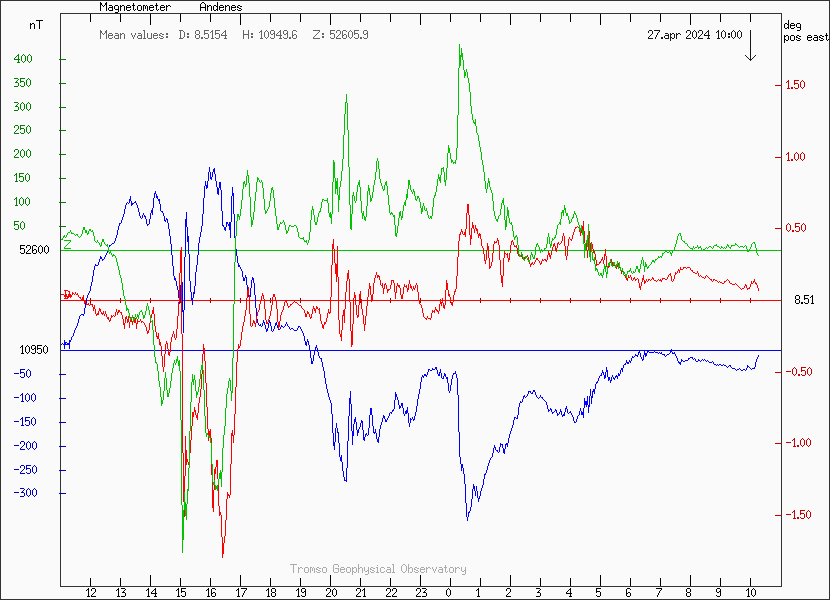
The geomagnetic field was at quiet to extremely severe storm levels on January 19. A very strong solar wind shock was recorded at 18:59 UT at SOHO, the arrival of the January 18 CME with a transit time of 25-26 hours, one of the fastest solar storms in history. The total field strength of the IMF at ACE peaked at 91 nT. Bz was initially strongly southwards peaking at 58 nT at 21:03, then northwards after 21:06 UT. Solar wind speed at SOHO ranged between 364 and 1001 km/sec, averaging 533 km/sec (-45 km/sec compared to the previous day). The high latitude magnetometer at Andenes was at quiet to very severe storm levels. The above 10 MeV proton flux peaked at 37000 pfu at 19:15 UT, the strongest solar radiation storm since 1991.
Solar flux density measured at 20h UT on 2.8 GHz was 173.4 - increasing 31.8 over the previous solar rotation.
The 365 day average solar flux at 1 AU was 152.03 (183 days ago). The 81 day average solar flux at 1 AU was 144.5 (41 days ago, this is 47.7% of the total SC25 solar flux range from the max 81 day average peak on September 4, 2024 at 227.3 and an average 81 day flux of 69 at solar minimum). SC25 365d peak: 195.9 on October 13, 2024.
The Potsdam WDC planetary A index was 73 (STAR Ap - based on the average of three hour interval ap indices: 73.3). Three hour interval K indices: 31011389 (planetary), 22112499 (Boulder), 53122587 (Andenes).
The background x-ray flux is at the class C1 level (GOES 19).
At the time of counting spots (see image time), spots were observed in 17 active regions using 2K resolution (SN: 370) and in 16 active regions using 1K resolution (SN: 263) SDO/HMI images.
AR 14341 [S10E06] was mostly quiet and in slow
decay.
AR 14342 [N16E09] was mostly quiet and stable. Note that SWPC groups AR
S11780 with this AR.
AR 14343 [S11W44] decayed significantly and was mostly quiet.
AR 14344 [N19W02] decayed slowly and quietly.
AR 14345 [S17E11] developed further and produced a number of C flares
and one M flare. The region has polarity intermixing and further M flares
are possible. C1 flares: C1.9 @ 11:01, C1.9 @ 13:48, C1.9 @ 22:21 UT
AR 14346 [S15E26] decayed slowly and quietly.
AR 14347 [N10E34] was quiet and stable.
AR 14348 [S18W15] developed slowly and quietly.
New AR 14349 [S13E74] rotated into view on January 18 and was
numbered the next day by SWPC.
New AR 14350 [N20E57] rotated into view on January 18 and received
its NOAA number the following day.
New AR 14351 [S04E47] emerged on January 18 with SWPC noticing the
region the next day.
Spotted regions not observed (or interpreted
differently) by SWPC/USAF:
AR S11769 [N17W37] reemerged with a tiny spot.
AR S11780 [N12E10] developed further and
produced a few low level C flares. C1 flares: C1.9 @ 17:33 UT
AR S11788 [N05E19] was quiet and stable.
New AR S11790 [S01E38] emerged with tiny spots.
New AR S11792 [S01W22] emerged with tiny spots.
New AR S11793 [N18E71] rotated into view with a tiny spot.
C2+ flares
| Magnitude | Peak time (UT) | Location | Source | Recorded by | Comment |
| C5.9 | 00:02 | 14342 | GOES18 | ||
| C4.7 | 00:33 | S11780 | GOES18 | ||
| C4.6 | 00:50 | 14345 | GOES18 | ||
| C3.7 | 01:53 | 14345 | GOES18 | ||
| C4.7 | 02:12 | behind southwest limb | 14336 | GOES18 | |
| C6.4 | 02:33 | behind southwest limb | 14336 | GOES18 | |
| C3.1 | 04:03 | behind southwest limb | 14336 | GOES18 | |
| C3.3 | 04:25 | 14345 | GOES18 | ||
| C3.3 | 05:24 | 14350 | GOES18 | ||
| C3.2 | 05:59 | S11780 | GOES18 | ||
| C3.8 | 06:10 | 14336 | GOES18 | ||
| C2.6 | 07:15 | GOES18 | |||
| C3.1 | 07:40 | GOES18 | |||
| C2.3 | 08:25 | 14345 | GOES18 | ||
| C2.5 | 08:31 | S11780 | GOES18 | ||
| C2.2 | 09:35 | 14345 | GOES18 | ||
| C2.1 | 10:32 | 14345 | GOES18 | ||
| M1.2 | 11:19 | 14345 | GOES18 | ||
| C2.3 | 12:00 | S11780 | GOES18 | ||
| C2.8 | 12:27 | 14345 | GOES18 | ||
| C3.4 | 13:07 | S11780 | GOES18 | ||
| C2.3 | 13:21 | 14345 | GOES18 | ||
| C3.6 | 14:04 | 14345 | GOES18 | ||
| C2.6 | 14:18 | 14345 | GOES18 | ||
| C2.2 | 14:36 | S11780 | GOES18 | ||
| C2.2 | 14:52 | 14345 | GOES18 | ||
| C2.6 | 14:59 | S11780 | GOES18 | ||
| C3.6 | 15:31 | 14345 | GOES18 | ||
| C2.8 | 15:48 | GOES18 | |||
| C3.8 | 17:58 | 14345 | GOES18 | ||
| C8.0 | 19:21 | 14345 | GOES18 |
January 17, 19: No obviously Earth directed CMEs were observed in
available coronagraph imagery.
January 18: A full halo CME was observed after the X1.9 flare in AR
14341. The CME impacted Earth during the evening of January 19.
[Coronal
hole history (since October 2002)]
[Compare today's report to the situation one solar rotation ago:
28 days ago
27 days ago
26 days ago]
A huge recurrent trans equatorial positive polarity coronal hole (CH1340) will be Earth facing on January 15-22.
The geomagnetic field is expected to be at unsettled to severe storm levels on January 20 and quiet to major storm on January 21 due to CME effects. The disturbance associated with CH1340 could resume on January 22.
| Coronal holes (1) | Coronal mass ejections (2) | M and X class flares (3) |
1) Effects from a coronal hole could
reach Earth within the next 5 days. When the high speed stream has arrived
the color changes to green.
2) Effects from a CME are likely to be observed at Earth within 96 hours.
3) There is a possibility of either M or X class flares within the next 48 hours.
Green: 0-30% probability, Yellow: 30-70% probability, Red: 70-100% probability.

(Click on image for 2K resolution).
4K resolution.
Compare to the previous day's image. 0.5K image
When available the active region map has a coronal hole polarity overlay where red (pink) is negative and blue is positive.
Data for all officially numbered solar regions according to the Solar Region Summary provided by NOAA/SWPC, all other regions are numbered sequentially as they emerge using the STAR spot number. Comments are my own, as is the STAR spot count (spots observed at or inside a few hours before midnight) and data for regions not numbered by SWPC or where SWPC has observed no spots. SWPC active region numbers in the table below and in the active region map above are the historic SWPC/USAF numbers. SWPC data considered to be not sufficiently precise (location, area, classification) are colored red.
| Active region | SWPC date numbered STAR detected |
Spot count | Location at midnight | Area | Classification | SDO / HMI 4K continuum image with magnetic polarity overlays |
Comment | ||||
|---|---|---|---|---|---|---|---|---|---|---|---|
| SWPC/ USAF |
STAR | SWPC | STAR | Current | Previous | ||||||
| 2K | 1K | ||||||||||
| 14340 | 2026.01.10 2026.01.11 |
N14W64 |
was AR S11760 location: N14W58 |
||||||||
| S11769 | 2026.01.13 | N08W30 | |||||||||
| 14341 | 2026.01.13 2026.01.14 |
12 | 45 | 23 | S11E03 | 0290 | DKC | DKO |
 |
 |
beta-gamma was AR S11770 area: 0790 location: S10E06 |
| 14342 | 2026.01.14 2026.01.14 |
15 | 7 | 3 | N14E10 | 0140 | DAI | CAO |
 |
 |
was AR S11772 area: 0230 location: N16E09 SWPC is including spots from AR S11780 |
| S11773 | 2026.01.14 | 1 | N17W37 |
 |
|||||||
| 14343 | 2026.01.14 2026.01.15 |
13 | 18 | 8 | S10W49 | 0110 | DAI | EAO |
 |
 |
was AR S11774 area: 0150 location: S11W44 |
| 14344 | 2026.01.15 | 5 | 14 | 5 | N18W01 | 0030 | DRO | DRO |
 |
 |
location: N19W02 |
| 14345 | 2026.01.15 2026.01.15 |
7 | 43 | 22 | S16E11 | 0030 | CRO | DAC |
 |
 |
beta-gamma was AR S11776 area: 0380 location: S17E11 SWPC data mismatch with physical reality |
| 14346 | 2026.01.15 2026.01.15 |
3 | 1 | S14E20 | 0005 | BXO |
 |
 |
was AR S11777 location: S15E26 |
||
| S11779 | 2026.01.15 | N12W08 | |||||||||
| S11780 | 2026.01.15 | 26 | 16 | N12E10 | 0270 | DAI |
 |
 |
|||
| 14347 | 2026.01.16 2026.01.16 |
1 | 2 | 2 | N11E34 | 0060 | HSX | CSO |
 |
 |
was AR S11781 area: 0150 location: N10E34 |
| S11783 | 2026.01.16 | N02E16 | |||||||||
| 14348 | 2026.01.18 2026.01.18 |
3 | 10 | 6 | S18W15 | 0020 | CRO | DRO |
 |
 |
was AR S11784 area: 0040 |
| 14350 | 2026.01.18 2026.01.19 |
3 | 8 | 3 | N20E56 | 0020 | DRO | CRO |
 |
 |
was AR S11786 location: N20E57 |
| 14351 | 2026.01.18 2026.01.19 |
2 | 7 | 5 | S05E46 | 0020 | DRO | DRO |
 |
 |
was AR S11787 area: 0040 location: S04E47 |
| S11788 | 2026.01.18 | 2 | 1 | N05E19 | 0006 | BXO |
 |
 |
|||
| 14349 | 2026.01.18 2026.01.19 |
1 | 4 | 3 | S14E73 | 0020 | HSX | DKO |
 |
 |
was AR S11789 area: 0380 location: S13E74 |
| S11790 | 2026.01.19 | 5 | 2 | S01E38 | 0030 | DRO |
 |
||||
| S11792 | 2026.01.19 | 4 | 2 | S01W22 | 0010 | BXO |
 |
||||
| S11793 | 2026.01.19 | 1 | 1 | N18E71 | 0003 | AXX |
 |
||||
| Total spot count: | 62 | 200 | 103 | ||||||||
| Sunspot number: | 162 | 370 | 263 | (total spot count + 10 * number of spotted regions) | |||||||
| Weighted SN: | 107 | 260 | 163 | (Sum of total spot count + classification weighting for each AR. Classification weighting: X=0, R=3, A/S=5, H/K=10) | |||||||
| Relative sunspot number (Wolf number): | 178 | 204 | 210 | ||||||||
| Month | Average solar flux | International sunspot number (WDC-SILSO) |
Smoothed sunspot number (4) | Average
ap (3) |
|
|---|---|---|---|---|---|
| Measured | 1 AU | ||||
| 2024.05 | 187.7 | 191.9 | 172.1 | 149.1 (+4.6) | 23.56 (SC25 peak) |
| 2024.08 | 246.1 (SC25 peak) |
252.2 | 216.0 (SC25 peak) | 156.8 (+1.8) | 15.96 |
| 2024.10 | 221.0 | 219.6 | 165.8 | 160.9 (+1.5) (SC25 solar max) | 18.99 |
| 2024.11 | 199.6 | 195.3 | 154.1 | 157.2 (-3.7) | 9.33 |
| 2024.12 | 197.3 | 191.2 | 154.6 | 151.2 (-6.0) | 8.42 |
| 2025.01 | 190.3 | 184.2 | 137.0 | 146.2 (-5.0) | 13.17 |
| 2025.02 | 184.2 | 179.7 | 155.7 | 139.8 (-6.4) | 14.42 |
| 2025.03 | 163.7 | 162.1 | 134.2 | 135.9 (-3.9) | 15.96 |
| 2025.04 | 162.5 | 163.6 | 141.4 | 133.3 (-2.6) | 17.62 |
| 2025.05 | 135.3 | 138.3 | 78.5 | 128.6 (-4.7) | 17.26 |
| 2025.06 | 131.3 | 135.4 | 114.6 | 124.7 (-3.9) | 21.43 |
| 2025.07 | 137.8 | 142.3 | 125.9 | (122.4 projected, -2.3) | 11.80 |
| 2025.08 | 154.9 | 158.7 | 133.7 | (119.3 projected, -3.1) | 9.97 |
| 2025.09 | 154.4 | 156.0 | 129.7 | (115.8 projected, -3.5) | 14.02 |
| 2025.10 | 139.5 | 138.6 | 114.6 | (111.8 projected, -4.0) | 15.64 |
| 2025.11 | 140.3 | 137.3 | 91.7 | (109.6 projected, -2.2) | 21.01 |
| 2025.12 | 160.8 | 155.8 | 124.0 | (108.0 projected, -1.6) | 13.35 |
| 2026.01 | 143.5 (1) | 63.7 (2A) / 103.9 (2B) / 133.1 (2C) | (104.0 projected, -4.0) | (14.8) | |
| 2026.02 | (99.9 projected, -4.1) | ||||
| 2026.03 | (95.5 projected, -4.4) | ||||
| 2026.04 | (91.8 projected, -3.7) | ||||
| 2026.05 | (90.5 projected, -1.3) | ||||
| 2026.06 | (88.4 projected, -2.1) | ||||
1) Running average based on the daily 20:00 UTC observed solar flux value
at 2800 MHz and any corrections applied to that measurement.
2A) Current impact on the monthly sunspot number based on the Boulder
(NOAA/SWPC) sunspot number (accumulated daily sunspots / month days).
2B) Boulder SN current month average to date.
2C) STAR SDO 1K Wolf number 27 day average.
3) Running average based on the quicklook and definitive Potsdam WDC ap
indices. Values in red
are based on the definitive international
GFZ Potsdam WDC ap
indices.
4) Source: WDC-SILSO, Royal Observatory
Of Belgium, Brussels

Sunspot activity was on a decreasing trend from September
2024 until mid August 2025 (using the average solar flux over 3 solar rotations as a proxy).
Then a strong surge in activity saw solar flux peak in late August 2025 just
below the largest peaks seen in 2024. A slow decrease in activity from the
August level has been observed in September and October 2025.
All 365 day smoothed sunspot numbers reached a maximum on October 11-12, 2024.
This became the peak of SC25 (365 day smoothed peaks: STAR 1K: 236.1, STAR 2K: 364.3, NOAA SN: 156.0, ISN: 163.9),
while the 365d
smoothed solar flux peaked on October 13, 2024, just 1.7% below the SC23
peak, and 62.6% above the SC24 peak.
--------------------------------------------------------------------------------------
This report has been prepared by Jan Alvestad. It is based on the analysis of data from whichever sources are available at the time the report is prepared. All time references are to Universal Time. Comments and suggestions are always welcome.
SDO images are courtesy of NASA/SDO and the AIA, EVE, and HMI science teams.