
Last major update issued on May 4, 2006 at 04:10 UTC.
[Solar and
geomagnetic data - last month (updated daily)]
[Solar wind and
electron fluence charts (updated daily)]
[Solar cycles 21-23
(last update April 1, 2006)]
[Solar cycles 1-20]
[Graphical comparison
of cycles 21, 22 and 23 (last update April 1, 2006)]
[Graphical
comparison of cycles 2, 10, 13, 17, 20 and 23 (last update April 1, 2006)]
[Historical solar and
geomagnetic data charts 1954-2005 (last update March 3, 2006)]
[Archived reports (last update
May 3, 2006)]
The geomagnetic field was inactive to quiet on May 3. Solar wind speed ranged between 272 and 314 (all day average 282) km/sec. A weak disturbance began after 18h UTC.
Solar flux measured at 20h UTC on 2.8 GHz was 89.0. The planetary A index
was 3 (STAR Ap - based on the mean of three hour interval ap
indices: 3.4).
Three hour interval K indices: 10000112 (planetary), 11001112 (Boulder).
The background x-ray flux is at the class B1 level.
At midnight there were 5 spotted regions on the visible solar disk. The solar flare activity level was very low. No C class events were recorded during the day.
Region 10875 decayed slowly and quietly.
Region 10878 was quiet and stable.
Region 10879 developed slowly and was quiet.
Spotted regions not numbered by NOAA/SEC:
[S650] This region emerged in the southeast quadrant on May 3.
Location at midnight: S12E23
[S651] A new region rotated into view at the southeast limb on May 3.
Location at midnight: S08E72.
April 30: A very faint CME may have been associated to a C1.8 flare in
region 10875. LASCO C2 images has traces of this CME just before noon.
May 1: A faint full halo CME was observed in LASCO C2 images from 16:30
UTC and was likely associated to a long duration C1 event in region 10875.
May 2-3: No partly or fully Earth directed CMEs were observed in LASCO
imagery.
Coronal hole history (since late October 2002)
Compare today's report with the situation one solar rotation ago:
28 days ago
27 days ago
26 days ago
A recurrent trans equatorial coronal hole (CH222) was in an Earth facing position on May 2-4.
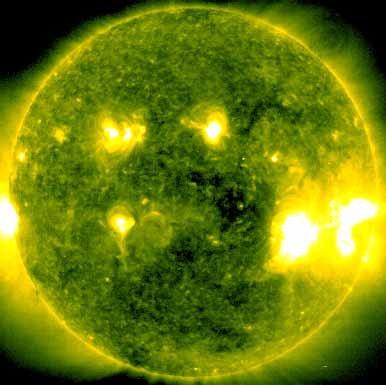
Processed SOHO/EIT 284 image at 01:06 UTC on May 4. The darkest areas on the solar disk are likely coronal holes.
The geomagnetic field is expected to be quiet to active on May 4 due to the arrival of slow CMEs. A strong high speed stream from CH222 will likely reach Earth on May 5 and cause unsettled to minor or major storm conditions that day and on May 6. Quiet to active conditions are likely on May 7.
| Coronal holes (1) | Coronal mass ejections (2) | M and X class flares (3) |
1) Effects from a coronal hole could reach Earth
within the next 5 days. When the high speed stream has arrived the color changes to green.
2) Effects from a CME are likely to be observed at Earth within 96 hours.
3) There is a possibility of either M or X class flares within the next 48 hours.
Green: 0-20% probability, Yellow: 20-60% probability, Red: 60-100% probability.
Long distance low and medium frequency (below 2 MHz) propagation along east-west paths over high and upper middle latitudes is fair to good. Propagation on long distance northeast-southwest paths is very poor to poor. Trans Atlantic propagation conditions are normally monitored every night on 1470 kHz. WLAM Lewiston ME and WWNN Pompano Beach FL were both audible at times. Lots of stations east of a line from Illinois to Texas were heard with the best signals between 700 and 1400 kHz. Unusually for the season it was possible to listen to 840 WHAS and 1160 WYLL.
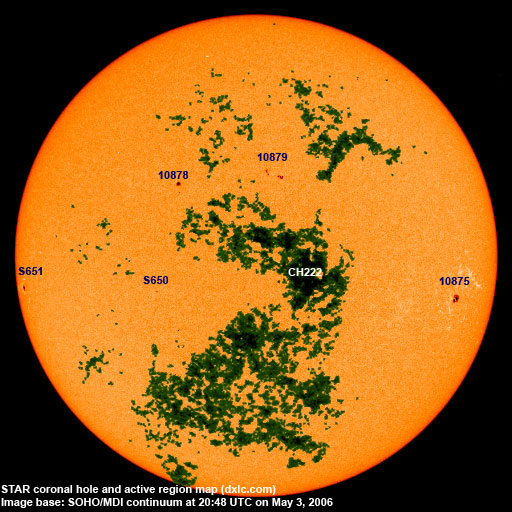
Compare to the previous day's image.
Data for all numbered solar regions according to the Solar Region Summary provided by NOAA/SEC. Comments are my own, as is the STAR spot count (spots observed at or inside a few hours before midnight) and data for regions not numbered by SEC or where SEC has observed no spots. SEC active region numbers in the table below and in the active region map above are the historic SEC/USAF numbers.
| Active region | Date numbered | SEC spot count |
STAR spot count |
Location at midnight | Area | Classification | Comment |
|---|---|---|---|---|---|---|---|
| 10875 | 2006.04.23 | 3 | 5 | S12W60 | 0180 | DAO | classification was HAX at midnight |
| 10876 | 2006.04.24 | 2 | S17W29 | 0020 | BXO | spotless | |
| 10877 | 2006.04.26 | S05W41 | plage | ||||
| 10878 | 2006.04.26 | 1 | 1 | N14E18 | 0040 | HSX | |
| 10879 | 2006.05.02 | 6 | 10 | N17W05 | 0100 | DSO | classification was DAO at midnight, area 0060 |
| S647 | 2006.04.29 | N08W24 | plage | ||||
| S650 | 2006.05.03 | 2 | S12E23 | 0010 | AXX | ||
| S651 | 2006.05.03 | 1 | S08E72 | 0050 | HAX | ||
| Total spot count: | 12 | 19 | |||||
| SSN: | 52 | 69 | |||||
| Month | Average solar flux at Earth |
International sunspot number | Smoothed sunspot number |
|---|---|---|---|
| 2000.04 | 184.2 | 125.5 | 120.8 cycle 23 sunspot max. |
| 2000.07 | 202.3 | 170.1 | 119.8 |
| 2001.12 | 235.1 | 132.2 | 114.6 (-0.9) |
| 2005.02 | 97.2 | 29.2 | 33.9 (-0.7) |
| 2005.03 | 89.9 | 24.5 | 33.5 (-0.4) |
| 2005.04 | 86.0 | 24.2 | 31.6 (-1.9) |
| 2005.05 | 99.3 | 42.7 | 28.9 (-2.7) |
| 2005.06 | 93.7 | 39.3 | 28.8 (-0.1) |
| 2005.07 | 96.4 | 40.1 | 29.1 (+0.3) |
| 2005.08 | 90.5 | 36.4 | 27.4 (-1.7) |
| 2005.09 | 91.1 | 21.9 | 25.8 (-1.6) |
| 2005.10 | 77.0 | 8.5 | 25.5 (-0.3) |
| 2005.11 | 86.3 | 18.0 | (24.5 predicted, -1.0) |
| 2005.12 | 90.7 | 41.2 | (21.8 predicted, -2.7) |
| 2006.01 | 83.4 | 15.4 | (18.7 predicted, -3.1) |
| 2006.02 | 76.5 | 4.7 | (15.6 predicted, -3.1) |
| 2006.03 | 75.4 | 10.8 | (13.4 predicted, -2.2) |
| 2006.04 | 89.0 | 30.2 | (12.7 predicted, -0.7) |
| 2006.05 | 90.2 (1) | 5.1 (2) | (12.2 predicted, -0.5) |
1) Running average based on the
daily 20:00 UTC observed solar flux
value at 2800 MHz.
2) Unofficial, accumulated value based on the Boulder (NOAA/SEC)
sunspot number. The official international sunspot number is typically
30-50% lower.
This report has been prepared by Jan Alvestad. It is based partly on my own observations and analysis, and partly on data from some of these solar data sources. All time references are to the UTC day. Comments and suggestions are always welcome.
| [DX-Listeners' Club] |